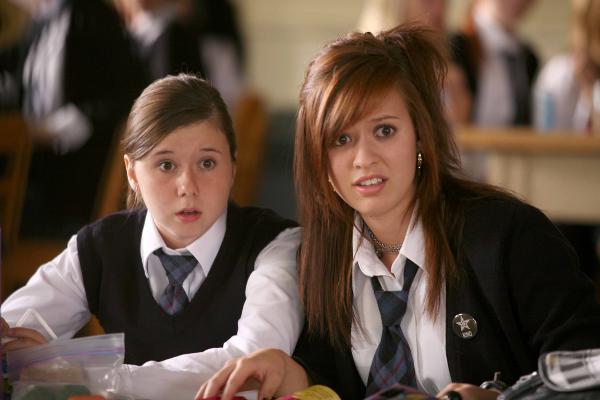
Journal d’Aurélie Laflamme, Le – Film de Christian Laurence

Le Journal d’Aurélie Laflamme est une comédie pour adolescents dont le personnage principal est tiré de la populaire série de livres écrits par l’auteure India Desjardins.

Le journal d’Aurélie Laflamme de Christian Laurence

Le journal d’Aurélie Laflamme de Christian Laurence

Le Journal d’Aurélie Laflamme est une comédie pour adolescents dont le personnage principal est tiré de la populaire série de livres écrits par l’auteure India Desjardins. Ce film est basé sur le premier tome de la série « Aurélie Laflamme, Extraterrestre ou presque ». Le réalisateur Christian Laurence vient du domaine de la télévision et signe ici son premier long-métrage de cinéma.

Comme on pouvait s’en douter d’après les succès obtenus par les livres, Le Journal d’Aurélie Laflamme fut reçu chaleureusement par le jeune public québécois qui en fit l’un des succès au box office de 2010. Au niveau international, le film de Christian Laurence eut droit à quelques sélections dans les festivals francophones, sans toutefois se démarquer outre mesure.

Un second film tiré des aventures d’Aurélie Laflamme a été produit par la suite.

Résumé

Aurélie est une adolescente de 14 ans, un peu perdue et donc en quête de solutions. Entre les habitudes de sa mère sédentaire et les chicanes avec sa meilleure amie, elle rêve à son premier french kiss ! Mais au fond, Aurélie se sent bien seule dans l'’univers, surtout depuis la mort de son père, il ya 5 ans.

Et si son père était simplement un extraterrestre, ayant quitté la Terre pour rejoindre sa planète? Génétique oblige, Aurélie serait elle-même une extraterrestre! Ceci expliquerait bien des choses. Par exemple, pourquoi elle se sent si différente des autres (surtout de sa mère), pourquoi elle n'’est pas capable d’'enligner deux mots sans faire une gaffe, et surtout pourquoi les garçons lui tapent vraiment sur les nerfs.

Synopsis officiel

Distribution

Marianne Verville (Aurélie Laflamme) ; Geneviève Chartrand (Kat) ; Aliocha Schneider (Nicolas) ; Jérémie Essiambre (Truch) ; Edith Cochrane (mère d’Aurélie) ; Pierre Gendron (Denis Beaulieu) ; Valérie Blais (Marie-Claude) ; Sylvie Potvin (Soeur Rose)

Fiche technique

Genre: Comédie dramatique - Origine: Québec, 2009 - Sortie en salles: 23 avril 2010 dans 83 salles au Québec - Durée: 1h48 - Classement: Général - Tournage: septembre-octobre 2009 - Budget approximatif: 4,1 M$

Réalisation : Christian Laurence - Scénario : Christian Laurence et India Desjardins, d'après le roman éponyme d'India Desjardins - Production : Claude Veillet et Lucie Veillet - Société de production : Films Vision 4 - Distribution : TVA Films

Équipe technique - Costumes : Julie-Anne Tremblay - Direction artistique : Marc Ricard - Montage : Hubert Hayaud - Musique : Martin Léon - Photographie : Geneviève Perron

Rules must apply today, tomorrow, and with both parents.

True discipline comes from connection, not fear. When a boy feels understood, he is much more likely to respect the boundaries you set. 1. Connection Before Correction

A boy who feels disconnected from his parents or teachers will often express his frustration through rebellion. Spend time engaging in his interests—whether that means playing video games, throwing a football, or building models. When a crisis occurs, your correction will be received as guidance rather than an attack on his character. 2. Clear, Consistent Boundaries

Because boys are often action-oriented, abstract punishments (lectures, lengthy groundings) are frequently ineffective. Discipline should be logical and restorative.

**Title: The Architecture of Character: A Comprehensive Analysis of Discipline for Boys

By implementing this feature, boys can develop essential life skills, self-discipline, and responsibility, setting them up for success in various aspects of life.

Consequence: The controller is taken away for the rest of the day. C. Active "Time-In" or Time-Outs

Society frequently tells boys to suppress their emotions, which leads to outbursts of anger or aggression. Anger is often a secondary emotion masking vulnerability, frustration, fear, or sadness.

Here is a comprehensive framework for instilling deep, lasting discipline in boys, transforming them from impulsive children into purposeful young men. The True Definition of Discipline

If high energy is causing trouble, redirect it. "I see you need to run, let's run laps in the backyard," is better than "Stop running in the house!" 4. Teaching Emotional Intelligence

Discipline is most effective when a boy feels secure in his relationship with his caregivers. If the relationship is only about rules, he may become more secretive or rebellious.

Toddlers are impulsive explorers who do not yet understand cause and effect. Their world is based on sensation and curiosity. Safety is the primary concern.

Boys are often more kinesthetic (physically oriented) learners. They may struggle to articulate emotions verbally, leading to acting out as a form of communication. When a boy "misbehaves," it is frequently a manifestation of an unmet need or an inability to process complex emotions verbally.

This mindset minimizes accountability. It suggests that aggression, disrespect, or lack of discipline are inherent male traits that must be tolerated. This approach fails boys by denying them the opportunity to learn accountability and emotional intelligence. It reinforces the "alpha" myth and often leads to the development of entitled adults who lack empathy.

The prefrontal cortex manages impulse control, future planning, and risk assessment. In boys, this area matures later than in girls, often continuing into their mid-20s.

Long lectures do not work well with boys. After a few minutes of talking, their brains often tune out.

During a calm moment, have a family meeting to discuss rules and what the consequences will be if they are broken.